
Indian Myna Control for Commercial & Industrial Sites
Acridotheres tristis
Invasive pest speciesThe common or Indian myna is an aggressive invasive species that roosts communally in large, noisy flocks. It exploits roof voids, signage and ledges on commercial buildings, fouling structures and displacing indigenous birds. Because mynas are bold and adaptable, they need a physical exclusion approach rather than scaring devices.
BCS treats myna infestations with the same survey-first, guarantee-backed process it has used since 1987, combining exclusion netting for roosts with repellent gel on perching surfaces.
How to identify
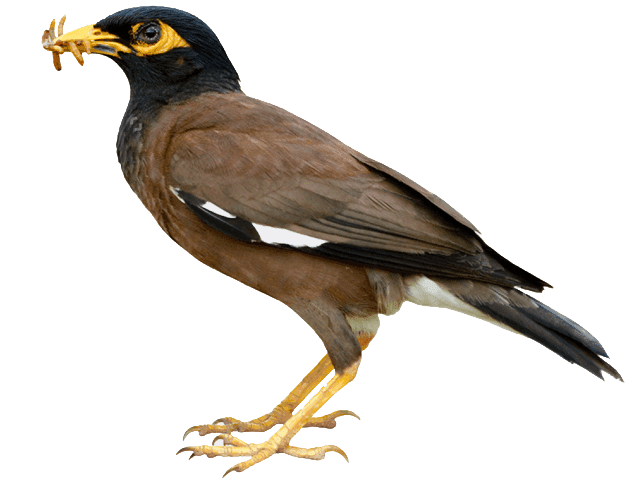
- Brown body with a glossy black head and a distinctive yellow eye patch and legs.
- White wing patches visible in flight.
- Roosts communally in large, loud flocks, often in roof voids, trees and signage.
- Highly territorial and confident around people and buildings.
Why indian mynas are a commercial risk
Communal myna roosts produce heavy, concentrated fouling and persistent noise. On commercial premises this means contaminated walkways and entrances, blocked drainage and complaints from staff and customers.
As an invasive species mynas also displace other birds and are difficult to dislodge once a roost is established, making early, permanent exclusion the most cost-effective response.
In commercial and industrial environments the damage concentrates where the roost sits. Corrosive droppings pit signage, canopies, parking structures and vehicles below; nesting material blocks gutters and fouls stock in receiving and loading areas. Active nests carry a mite and pathogen load that is a real concern near HVAC intakes and staff facilities, and mynas scavenging around canteens, waste areas and outdoor eating spaces are aggressive enough to drive genuine customer and staff complaints.
Concentrated fouling and corrosion
Large communal roosts foul and corrode entrances, walkways, signage and parking structures faster than most other pest birds.
Noise and nuisance
Loud dawn and dusk flocking disturbs staff, tenants and customers, a real issue for retail and hospitality sites.
Mite and pathogen load
Active roosts carry mites and pathogens that spread from nests near air intakes, staff areas and food-handling zones.
Roost entrenchment
Mynas are bold and territorial; an unaddressed roost only grows and becomes harder to remove.
The health hazards of indian mynas
Bird droppings, feathers and nesting debris are a genuine health hazard, not just a mess. As droppings dry they break down into dust that becomes airborne and is inhaled, while fresh fouling contaminates surfaces, food and water, and the nests carry biting parasites. The specific conditions associated with this species:
Salmonellosis & E. coli
Mynas shed Salmonella and E. coli in their droppings, contaminating food, water and surfaces and causing gastrointestinal illness, a serious risk in food and hospitality settings.
Psittacosis (ornithosis)
A bacterial infection (Chlamydia psittaci) transmitted from birds to people through inhaled dried droppings, causing flu-like illness and pneumonia.
Campylobacter & Salmonella carriage
As scavengers around waste and food areas, mynas readily pick up and spread enteric bacteria between refuse, ground and food-preparation zones.
Aspergillosis
A fungal respiratory infection (Aspergillus) linked to droppings and decaying nest material, a particular concern when roosts sit near HVAC air intakes.
Bird mites and ectoparasites
Large communal roosts carry heavy loads of bird mites that bite people and spread from nests into occupied areas near intakes and staff facilities.
Left unattended, indian mynas multiply
Mynas are prolific seasonal breeders, and as an aggressive invasive species with few local checks, their numbers climb fast once a roost is established.
Each season a myna roost adds several clutches per pair, and because the species out-competes local birds, little slows it down. Left unaddressed, a roost does not stabilise, it expands year on year.
One untreated pair, three years on
Illustrative growth of a single untreated breeding pair, with no control.
Numbers are illustrative and vary by site, the point is the shape. Bird populations compound, they do not plateau.
Recommended control for indian mynas
Specified to your site after a survey. Most jobs combine more than one of these systems.
Indian mynas questions, answered
Mynas roost communally in large flocks, so the fouling and noise are concentrated and intense. As an aggressive invasive species they also entrench quickly and displace other birds, which is why early, permanent exclusion is the most cost-effective response.
More species we control
Get rid of indian mynas for good
Book a free site survey and we'll scope a guaranteed, humane solution for your facility.