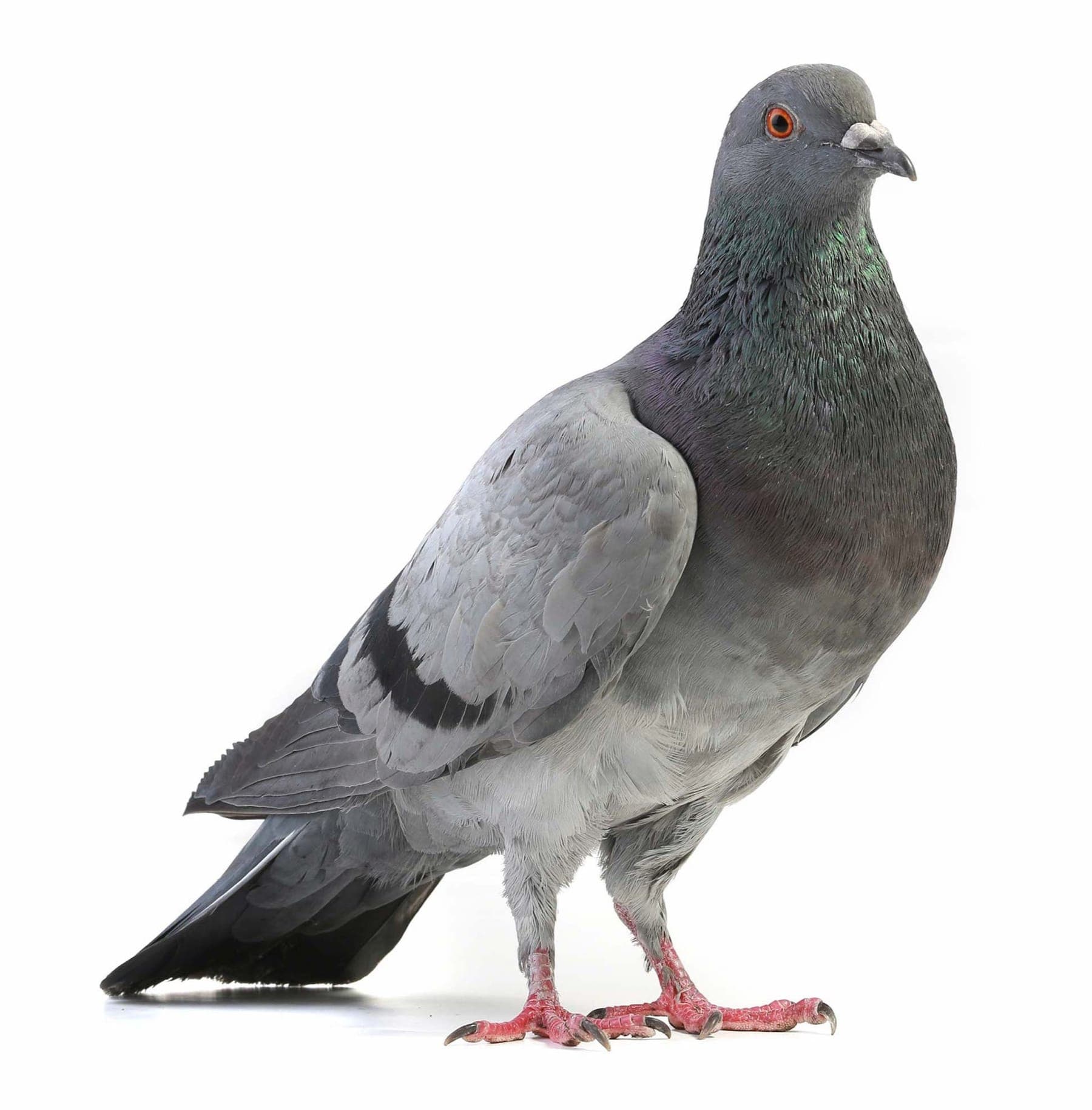
Of every bird that lands on a South African commercial or industrial building, the feral pigeon is the one that stays, breeds, and becomes an audit finding. It's the species behind most of the bird problems we're called to solve, and it's the one the University of KwaZulu-Natal tested our Vamoose gel against, recording a 100% reduction on treated ledges. If you manage a food plant, warehouse or industrial facility and you have a bird problem, the odds are it's this bird.
Why the feral pigeon, specifically
The feral pigeon (Columba livia domestica) is descended from the wild rock dove, a cliff-nesting species. That single fact explains almost everything about why it loves your building. To a pigeon, a warehouse roof void is a cliff cave. A parapet ledge is a rock shelf. Structural steel, pipe bridges and canopies are the ledges its ancestors nested on for millennia. Your building isn't being invaded by accident, it's being read as ideal habitat.
Three traits make the feral pigeon uniquely hard to shift:
- It's a resident, not a visitor. Pigeons don't migrate. Once a flock settles, it breeds on site year-round, up to several broods a year. What starts as a handful of birds becomes an established colony.
- It's strongly site-loyal. Pigeons return to the same roosting and nesting sites relentlessly. Clean the mess without removing the reason they're there, and they're back within days.
- It habituates to almost everything. Sonic scarers, plastic owls, flashing tape, gas cannons, pigeons learn to ignore them all, often nesting directly beside the deterrent that was meant to move them on.
That last point is why so many facilities cycle through cheap deterrents for years without resolving anything. The bird simply outlasts them.
What a pigeon colony actually costs you
The nuisance is the least of it. On a commercial or industrial site, an established pigeon population is a direct hit to compliance, hygiene, infrastructure and safety at once.
- Contamination and audit failure. Pigeon droppings carry organisms behind more than 40 diseases, including Salmonella and Listeria, the exact pathogens a food-safety plan exists to control. Evidence of pigeon activity is a legitimate major non-conformance under ISO 22000, FSSC 22000 and retailer audit schemes. For a food producer, that's not a housekeeping note; it's a threat to supply contracts.
- Product and stock loss. Droppings, feathers and nesting material fall onto open product, conveyors, packaging and stored goods. A single contamination incident can force a batch recall that costs more than a decade of proofing.
- Corrosion and structural damage. Pigeon droppings are acidic. They etch and corrode steel, cladding, paint and concrete, and nesting debris blocks gutters and downpipes, turning a bird problem into a water-ingress problem.
- A recorded safety hazard. Fouled walkways, ladders and platforms are a documented slip risk, and dried droppings become airborne dust that staff working below breathe in.
Why pigeons keep coming back, and what actually works
The mistake almost every failed pigeon programme makes is treating the symptom (the mess) instead of the cause (the habitat). Cleaning is a subscription that never ends. Scaring moves the problem a few metres along the facade. The only durable outcome comes from making the building unusable to the bird.
For feral pigeons, that means two things working together:
Take away the roosting surfaces. The exposed ledges, beams, parapets and steel that pigeons perch on get treated with our two-step Vamoose Bird Repellent Gel. Pigeons land, find the surface unsafe underfoot, and leave, and because the response is instinctive, they never habituate to it the way they do to scarers. The sealer step is what makes a BCS gel installation last up to 5 years, where single-step products stop working within 6 months.
Seal the nesting habitat. The roof voids, canopies and structural cavities where pigeons actually breed get closed off permanently with the custom-fabricated Spectre-Net exclusion system, backed by an 8-year workmanship guarantee. A building with no nesting habitat can't hold a colony.
On the hardest sites, both systems run together. It's the combination that BCS used to achieve, in the client's own words, the total eradication of nesting colonies at Transnet Port Terminals, and it's the approach behind five-plus years of pigeon control at Tiger Brands' snacks plants.
The starting point is always a survey
No two pigeon problems are identical, different roof geometry, different roosting network, different budget. That's why every BCS project starts with a survey that maps the building as a system and scopes exactly what to treat and what to net, in a bird risk assessment aligned with ISO 22000:2018 that you can put straight into your compliance file.
Have a pigeon problem on a commercial or industrial site? Book a free site survey and we'll give you a costed, guaranteed plan, or read how we get pigeons out of a warehouse for good.