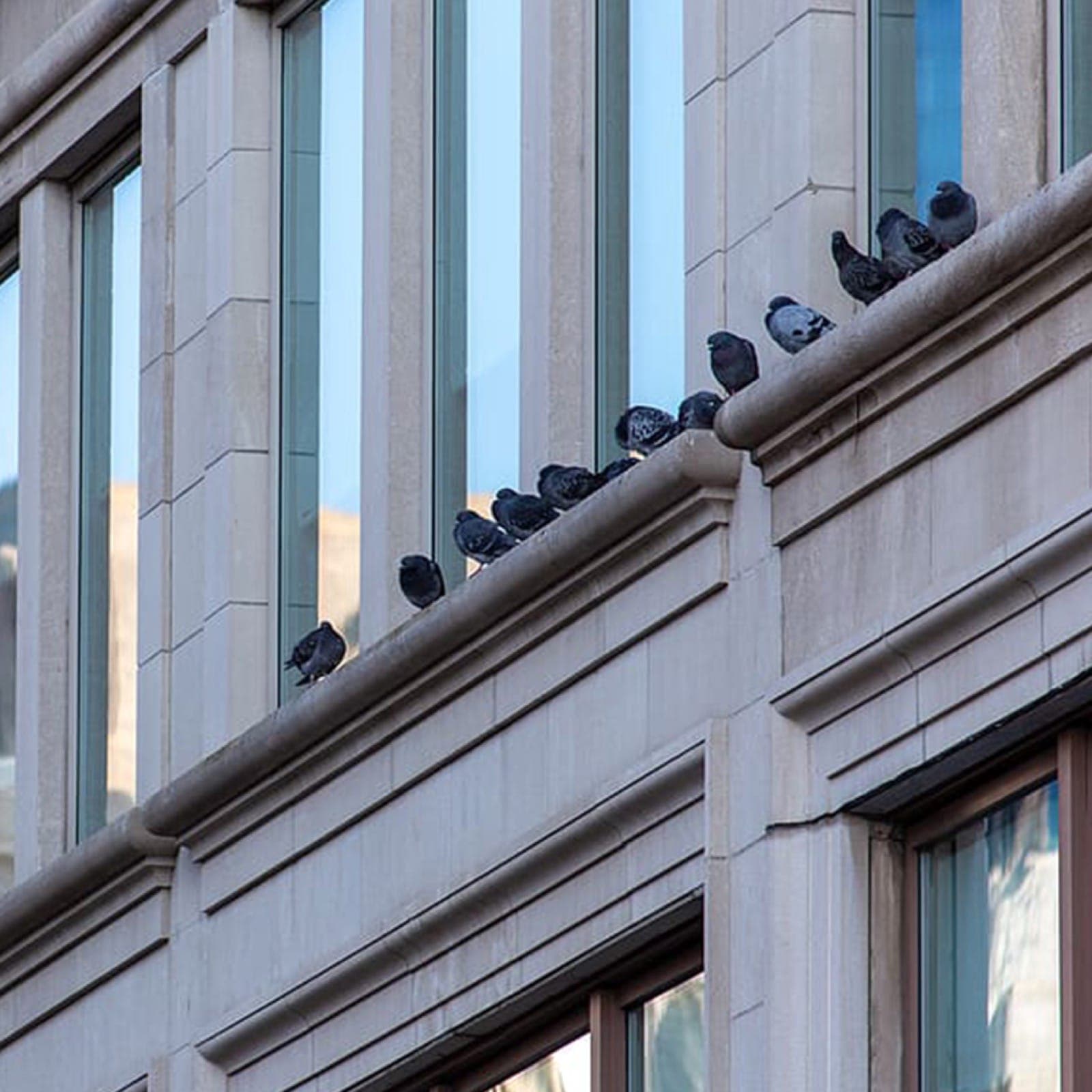
Ask a food-safety auditor what they think when they see pigeons roosting above a receiving bay, and you'll get a short answer: it's a finding. Not because auditors dislike birds, but because the science is settled. Bird droppings are associated with more than 40 diseases that can transfer to people and to product — and the conditions that let birds settle above a production line are, by definition, uncontrolled.
But "40 diseases" is the wrong way to think about the risk. It reads like a trivia statistic, and it lets people file the problem under "unpleasant" rather than "hazardous." What matters for your facility is not the length of the list. It's how birds move pathogens into your process, which organisms are realistic in a South African commercial or industrial setting, and why repeated cleaning never closes the gap.
How birds actually transmit disease
Birds rarely infect a product by touching it. The risk is almost always indirect, through four routes that a good HACCP or prerequisite programme is supposed to control:
- Aerosolised dust. Droppings dry on roof steel, ledges and cladding, then break down into a fine powder. Foot traffic, forklifts, roller doors and—critically—HVAC intakes lift that dust and carry it into spaces the droppings never physically reached.
- Direct contamination. Droppings fall onto open product, packaging, conveyors, pallets and potable-water tanks from birds perched above.
- Vectoring on people and equipment. Pathogens ride in on shoe soles, wheels and clothing from contaminated yards, roofs and mezzanines.
- Secondary pests. Nests are a habitat in their own right, harbouring mites, beetles and flies that then disperse through the building. More on that below—it's the layer most people miss.
Two principles follow from this. First, risk rises with accumulation and time: a fresh dropping is a hygiene issue, but a season's worth of dried guano above an air handler is a genuine airborne hazard. Second, the most dangerous moment is often the clean-up—dry-sweeping old droppings without proper respiratory protection puts the highest concentration of pathogens straight into the air a worker is breathing.
The organisms that matter most
Not every disease on the "40+" list is realistic in a warehouse or food plant. These are the ones worth understanding.
Foodborne bacteria
Salmonellosis. Salmonella lives in the gut of feral pigeons, starlings and sparrows and passes in their droppings. Once it dries and becomes dust, it travels far beyond the soiled surface. In a food environment it is the single most obvious reason an auditor will not tolerate active birds near product.
Listeriosis. South Africa knows precisely what Listeria monocytogenes costs. The 2017–2018 outbreak was the largest ever recorded worldwide, with over 200 deaths, and it reset how local processors think about environmental contamination. Birds are a recognised environmental vector, and Listeria's ability to survive and spread through a facility makes any uncontrolled entry point a serious liability.
Campylobacteriosis and E. coli. Campylobacter is one of the most common causes of bacterial gastroenteritis, and wild birds are a well-established reservoir. Pathogenic E. coli is spread the same way. Both reinforce the same point: droppings near food are a contamination route, not a cosmetic problem.
Airborne and respiratory diseases
This cluster is what makes accumulated droppings genuinely dangerous to staff, and it is consistently underestimated because the exposure is invisible.
Histoplasmosis. The fungus Histoplasma capsulatum grows in soil enriched by accumulated bird droppings. Disturbing that material releases spores that, when inhaled, can cause a serious respiratory infection—occasionally spreading beyond the lungs. Maintenance and cleaning crews are the group most at risk.
Cryptococcosis. Cryptococcus neoformans is strongly associated with pigeon droppings. In healthy adults infection is often mild, but it can cause severe lung disease and meningitis in people with weakened immune systems. In South Africa, where a significant portion of the population is immunocompromised, this is not an abstract concern—it is a real occupational-health consideration for anyone working around roosting pigeons.
Psittacosis (ornithosis). Caused by the bacterium Chlamydia psittaci and contracted by inhaling dried droppings or feather dust, psittacosis presents as a flu-like illness that can progress to serious pneumonia. It is frequently misdiagnosed precisely because few clinicians ask, "Do you work near birds?"
Hypersensitivity reactions. Beyond infection, chronic exposure to feather dust and dried droppings can trigger allergic respiratory conditions—often called "bird fancier's lung"—in sensitised workers. It is a slow, cumulative harm that rarely gets linked back to its source.
The hidden layer: parasites and secondary pests
A bird problem is never only a bird problem. Active nests are warm, sheltered and full of organic debris, which makes them ideal habitat for bird mites (such as Dermanyssus gallinae), ticks, fleas, carpet beetles and stored-product insects. When a nest is abandoned or the birds are excluded without proper clean-out, these parasites migrate into the building looking for a new host—biting staff and, in a food plant, introducing a fresh contamination and infestation problem. Any credible bird-control programme has to account for what lives in the nest, not just the bird.
A measured word on avian influenza and Newcastle disease
Avian influenza dominates headlines, and it deserves honest framing. The primary reservoirs are wild waterfowl and poultry, not the pigeons, starlings, sparrows and mynas that colonise commercial buildings, so the direct risk from pest species is comparatively low. But "low" is not "zero," particularly for sites near poultry operations or wetlands, and the same is true of Newcastle disease, which usually causes only mild conjunctivitis in humans. The responsible position is neither alarm nor dismissal: keep pest birds out of food and production environments, and the question becomes moot.
What an auditor is really assessing
An auditor is not going to lab-test a dropping. They are assessing whether your facility has controlled the conditions that allow contamination—which is exactly what ISO 22000, FSSC 22000 and HACCP prerequisite programmes require. Practically, that means they will look at:
- Birds, droppings or nests above or near receiving, production, storage or open product
- Evidence of accumulation—staining, guano build-up, feathers in light fittings or on ledges
- Proximity of roosting sites to air intakes and open doors
- Whether your response is a documented exclusion programme or just repeated cleaning
That last point is where most facilities lose marks. Cleaning removes the evidence; it does not remove the cause. As long as the birds can return, the finding returns with them.
Why cleaning is not control
Culling and repeated wash-downs are temporary and ongoing by nature—they treat the symptom while the underlying attraction of the site remains. Sustainable control works on access and behaviour: deny the birds the ledges and voids they roost in, and make the surfaces they favour unwelcome. That is a humane, permanent approach, and it is the one auditors want to see documented.
At BCS Bird Control Services, we deliver that through two proven, humane systems:
- Vamoose Bird Repellent Gel — a non-toxic gel applied to ledges, beams and roosting surfaces that birds instinctively avoid, discreet and long-lasting, and suitable for hygiene-sensitive environments.
- Spectre Net Exclusion Systems — UV-stabilised, custom-fitted netting that physically blocks access to roosting and nesting areas without harming the birds.
Get audit-ready before the next inspection
More than 40 diseases is a headline. The real story is simpler: birds above your process are an uncontrolled hazard, the risk grows quietly with every week of accumulation, and cleaning alone will never satisfy an auditor who understands the science.
Contact BCS Bird Control Services for a professional site survey. We'll identify where birds are creating risk, assess it against your compliance obligations, and design a guaranteed, humane exclusion programme that holds up on inspection day—and every day after.